


NYC Excursion to AMNH
November 22nd, 2025 ~ New York City
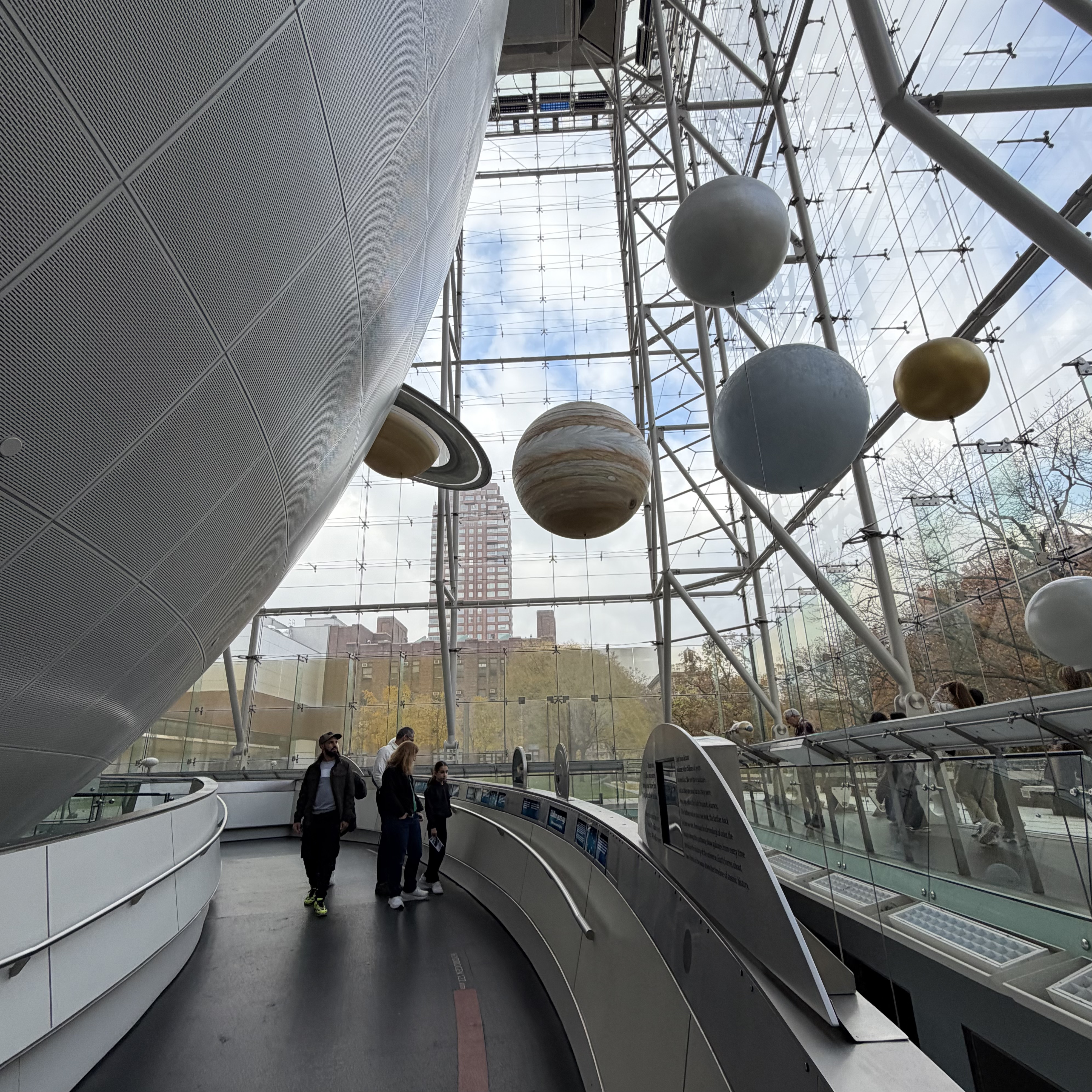
After a thrilling four-hour bus ride of doing homework and warding off sleep, we finally arrived at the Big Apple and the set of the famous film Night at the Museum. When we walked into the American Museum of Natural History, we were greeted by the presence of giant models of the planets and the large spherical Hayden Planetarium, and we began our Morning/Afternoon at the Museum excursion.
The first scene begins with a guided tour of the newly opened “Impact: The End of the Age of Dinosaurs” exhibit, which is about the asteroid impact that caused the extinction of dinosaurs. This exhibit illustrates the event so that as you walk through it, you enter seeing how the Earth was before, then you see a short video about what the impact was like, after it shows how the Earth and the life on it were impacted after the collision, and finally you can see what we might be able to do in the future to prevent an asteroid impact. One display in this exhibit is a large screen to watch an immersive short documentary that shows what happened when the Chicxulub hit and the chain of catastrophic events that it triggered globally. I think that the video is suitable for visitors of all ages and backgrounds because it uses visuals and audio descriptions of what it is showing. Another display inside this exhibit is a collection of life-sized models of some of the animals that lived on Earth that either went extinct or had to adapt and evolve after the impact. I think that these models are properly interpreted for visitors to see the size and scale of what some of the animals on Earth looked like and how those that didn’t go extinct changed to adjust to how the environment and climate were affected. This exhibit makes this event from 66 million years ago relevant to us humans in the modern day by comparing the animals that we have today to their distant relatives, and it also talks about the proposed methods that we could use to potentially protect ourselves from large objects in space.
When we finished the first guided tour, my group went on a self-guided observation of one of the halls. After searching far and wide (and doing a couple of loops around the museum), we finally found the Dorothy and Lewis B. Cullman Hall of the Universe. This hall is organized into four different zones: stars, planets, galaxies, and the universe. Three of the items in this exhibit are a coronagraph, the Willamette Meteorite, and a topographical model of the moon. The coronagraph is from the 60-inch wide telescope at the Palomar Observatory, and has labels showing the parts and processes of how it works. The Willamette Meteorite came from outer space, but landed in Oregon, and it is the largest meteorite found in the United States. Alongside the information about the meteorite itself, there is also a sign that describes its cultural significance. The model of the moon was made using data from the Clementine mission to show the craters of the moon. Some of the information that I wish were conveyed for these items is how the coronagraph was designed and built, more in-depth explanations of the scientific observations and findings that came from the discovery of the Willamette Meteorite, and the techniques that were used to survey and create an accurate topographic model of our moon, despite it being 384,400 kilometers away from us.
After we explored the universe, we went on our second guided tour in the fossil halls. The museum’s fossil halls are arranged to resemble a cladogram to organize the displays into groups based on their evolutionary relationships, and they put circles on the ground to mark where new evolutionary features are introduced. One highlight that I found interesting from the guided tour of the fossil halls was that humans have a shared common ancestor with the lobe-finned fish, and we can see similarities with our skeletal structure, and their fins have resemblances to our arms, legs, and hands. Another interesting highlight from the tour is that Placoderms, a group of prehistoric fish, were some of the first fish with jaws, and they had self-sharpening plates in their jaws. Similar to animals and plants on Earth, science also evolves, which means that some parts of this exhibit would need to be updated in order to reflect new findings. Two features of this exhibit that have become outdated are the beliefs of the evolutionary relations for the Tyrannosaurus Rex and also the turtles. The Tyrannosaurus Rex was formerly believed to be related to lizards and other reptiles, but it has recently been found to be closer to birds. The placement of turtles in the hall’s cladogram layout is also outdated, as it was placed when scientists thought that pareiasaurs were the closest ancestor to turtles, but now birds and crocodiles are closer relatives. Because of the layout of the museum, it would be very difficult and expensive to relocate the display, but one way that the updated information could be reflected for the visitors is by having signs to explain the correction needed and providing a small map for visitors to understand and connect the turtles to their appropriate section.
For the final scene of our Day at the Museum, we took a break from walking around and went to the giant spherical planetarium that we were greeted by that morning (one could say that we went “full circle”) to watch the Space Show. This year, the Space Show was called "Encounters in the Milky Way", which was about how objects move in space. The show discussed the motion of objects in our solar system and the Milky Way galaxy and used images and animated visualizations of the data that astronomers have collected. One new thing that I learned from this show was that other star systems have their own Oort clouds.
The American Museum of Natural History has a large and diverse collection of exhibits, and it is made for diverse audiences as well. Some ways that the museum accommodates visitors of all backgrounds and abilities are by having audio tours to explain what is being displayed, having interactive activities to engage and teach younger audiences, and also having some ramps and elevators that can be used for those who have different mobility needs. This excursion was a very fun and interesting experience that introduced me to new knowledge in topics that I had very little understanding of before my visit.