


How We Measure the Weather: A Brief History and Where We're Going Next
James Hyde
December 10th, 2025, 4:30 pm, Edward Saint John Teaching and Learning Center
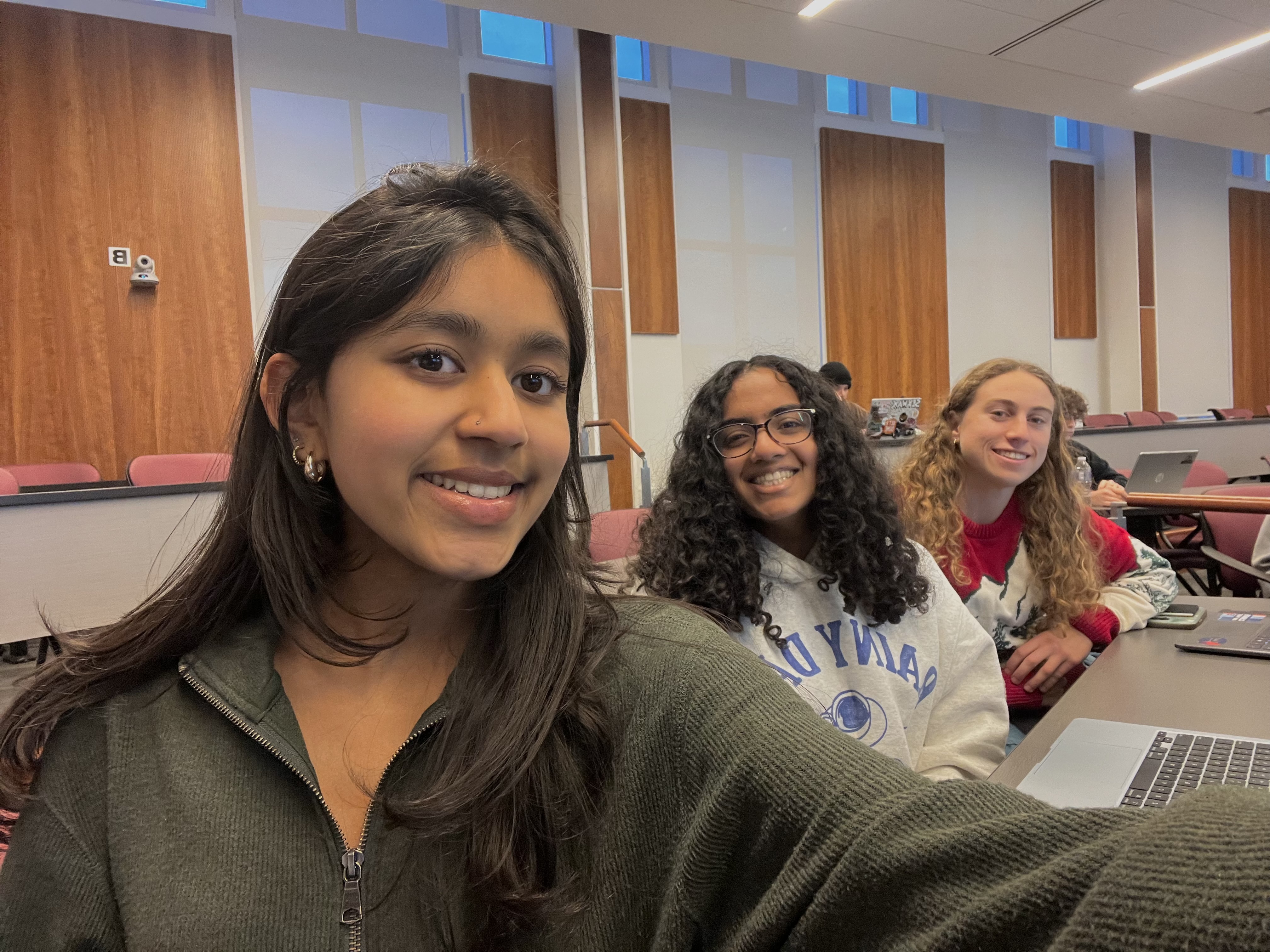
With fellow SGC scholars at the Seminar
Overall, I found the main points of the seminar to be very convincing and well-supported. The information presented throughout the entire presentation was educational, although at times Hydes used vocabulary and weather terminology above the average person's knowledge base. Since I am taking AOSC 200 (Weather and Climate) this semester, I was able to follow a lot of the information, but without that course and the brief amount we touched on in lecture, I would have been lost during some parts. Particularly while talking about weather stations, Hydes assumed the audience would know the standard conditions that would remove bias from the stations; however, this may not be information everyone knows. I felt a little bit lost at this time, but was able to use my knowledge from AOSC 200 to stay on track. Conversely, I felt that Hyde did a phenomenal job explaining the complexities of digitalizing weather data. He explained the differences in record-keeping from hand-written observations to automated systems. With hand-written data, a wider variety of information was recorded, allowing for a more complete set, recorded by a trained specialist. However, automated data entry systems allow backyard weather stations that are not necessarily cited to feed into climate data systems. These systems may be too close to the ground, sitting on pavement, next to heavy carbon-releasing runways at airports, or even overrun by weeds. This causes the data to be inaccurate and skews the information that is used to make important weather-related decisions. Hydes described the current solution, the Mesonet, that is being implemented to provide more reliable data and ensure quality observations. While he was explaining this, I thought of our first couple of lectures in class, where we discussed the scientific process and controlled experimentation. This is essential to ensure that results are representative of the actual conditions, both in weather observations and scientific experiments. One point that James Hyde emphasized that I do not fully agree with is that the weather impacts everyone equally. While I do agree that weather research and tracking is an essential topic because it does affect the whole population, it does not influence everyone in the same ways. Weather extremes often cause more damage to areas with dense populations, like urban centers. In these same areas, there is not always as much as access to money and, therefore, crisis relief and support services. For example, during intense heat waves in urban areas, the most densely packed parts of cities often do not have many buildings with air conditioning or other ways to escape the heat. I believe this topic is extremely nuanced and cannot be summed up into a simple phrase that weather affects everyone in the same way. Despite this, I thought the seminar was quite thoughtful and very informative. I learned a lot about the history of meteorology, as well as the future of meteorological observations. It was interesting to learn about these topics, and I think it is important to have a general knowledge base in meteorology, as it is an essential skill in everyday life.