Event name:Trip to National Air and Space Museum
Event time and place: February 22, 2026
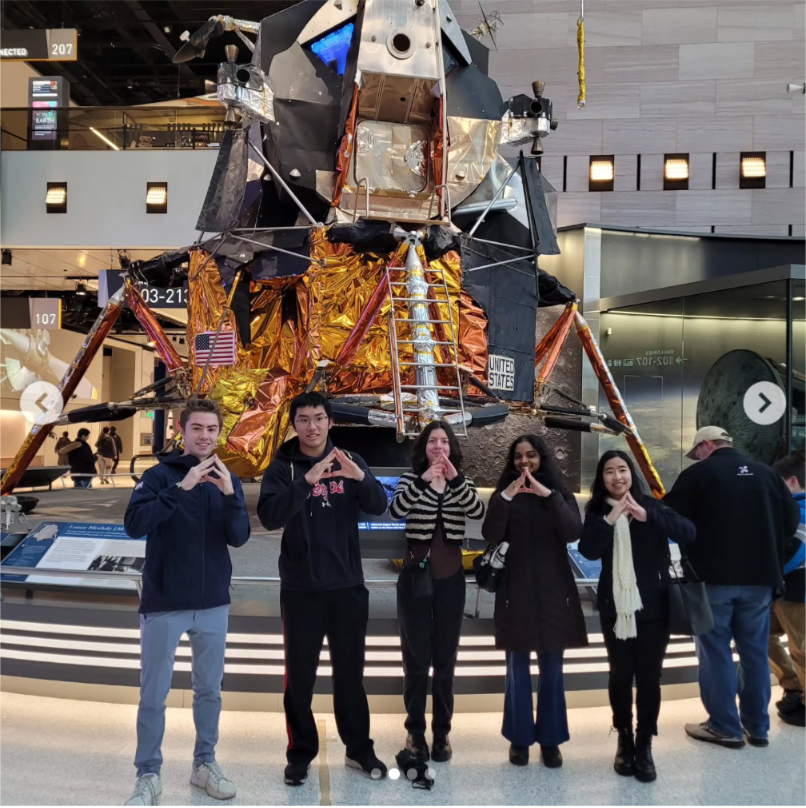
SGC Scholars at Air and Space Museum
It was a cold, rainy Sunday morning on February 22, 2026. Rain had been forecast with a slight chance for a wintry mix, the perfect day to spend indoors at the National Air and Space Museum in DC. Inside the Air and Space Museum, there were numerous exhibits and items on display. Greeting us at the entrance was a replica of the lunar landing module, where our small group of 5 students took our group photo. After our group photo, we were free to roam the rest of the museum at the various exhibits.
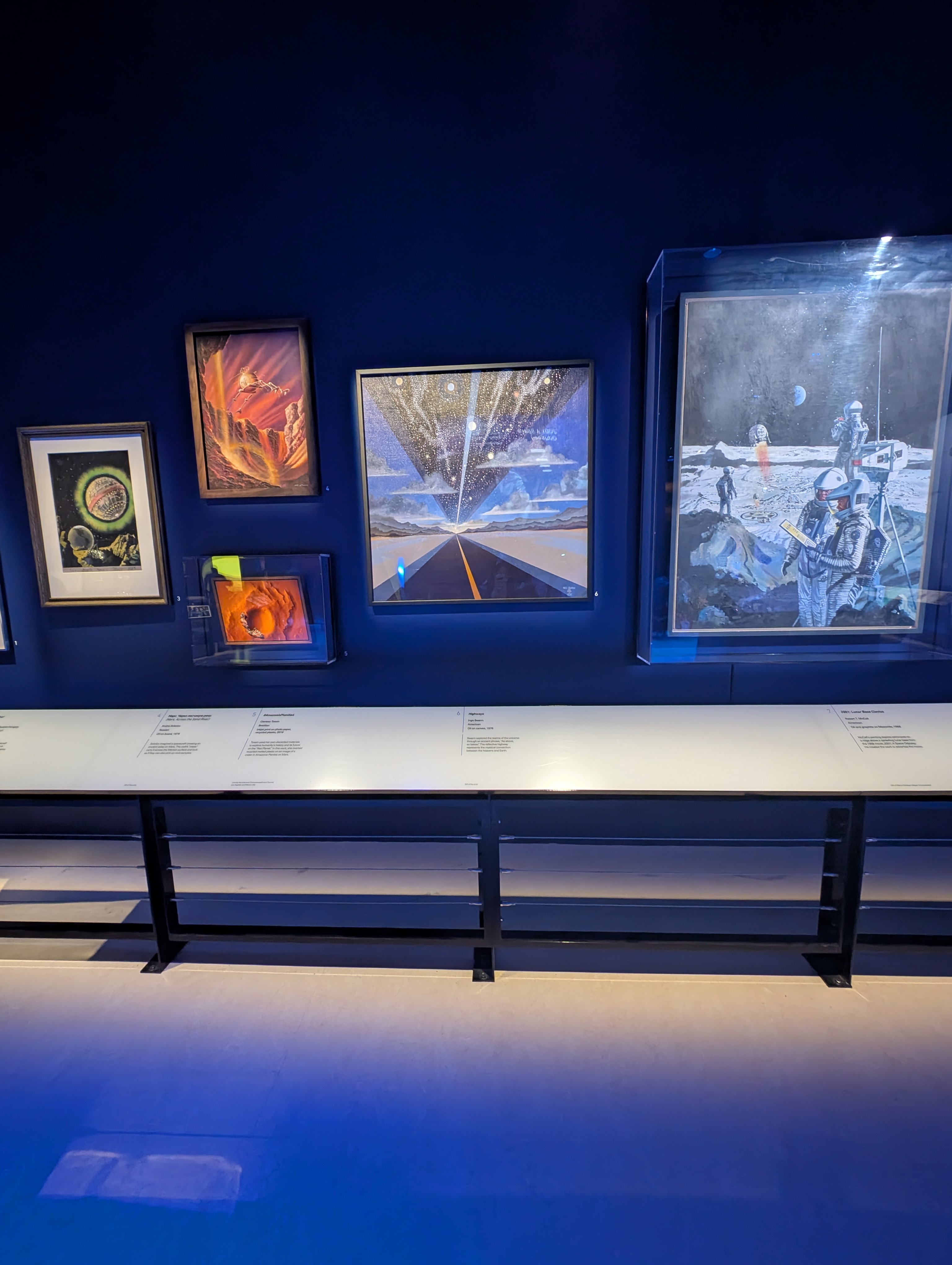
Collection of plaintings on display
The first exhibit that I visited was one titled Futures in Space, an exhibit dedicated to what the future of space exploration will look like, the challenges presented, and why people and institutions want to continue space exploration.A portion of the exhibition was dedicated to the possibility of living on Mars one day. Of course, one of the challenges with this is where people will live and how to effectively and efficiently build these homes. Some ideas proposed were inflatable homes or using 3d printers to build them. These two ideas both require material and engineering sciences to create materials that can withstand the harsh conditions of Mars while also being able to be built with materials that are either obtainable on Mars or light and not costly to take along on shuttles. Other technologies presented in this exhibit included plans for spaceports on the moon. There could potentially be spaceports on the moon one day that could lead to easier travel or even tourism. Another part of the exhibit explored more about the unique challenges that were in place for living on Mars. Besides the climate and sparseness of resources on Mars, one of the biggest challenges would be the social challenges of living isolated on an entirely different planet from the majority of humanity. Through a movie being played through a projector, patrons of the museum could experience a 360-degree view of the challenges and solutions presented to this part of living on Mars. Finally, a last aspect of aerospace that was in the exhibition was the prospects of profit and future companies on the moon. There was an interactive game that you could play, presenting the player with the options for starting a business in space, such as a resort on the moon. But while you start your business, there are things that you need to consider focusing on; are you going to focus on sustainability? Profit? Accessibility? These are all things that any business in space will need to consider, and are important aspects for a future in space. The gallery presented information in many different ways, one of which was through a collection and series of paintings. Along one of the walls of the exhibit lay dozens of paintings, all from different eras, made with different media, but all with the same subject, space. Whether it was a depiction of the planets or the galaxy above us, humanity's curiosity and connection to space and the unknown could be seen spanning across the room. This visual display was a beautiful way to show art and present that humans have always had a fascination with space. Another way that information was displayed was through a video showing the social challenges of living on Mars. The video was a great visual and immersive way to present this information. The education level for this exhibit was intended for all ages, but probably leaned more towards a slightly older audience, like high schoolers and up. Some of the language used was more scientific and would be better understood by an older audience, but there was still something for everyone in the exhibit through the games and interactive displays. This hall had sections where people could touch the items, and many computers that made it interactive and more engaging for the audience.
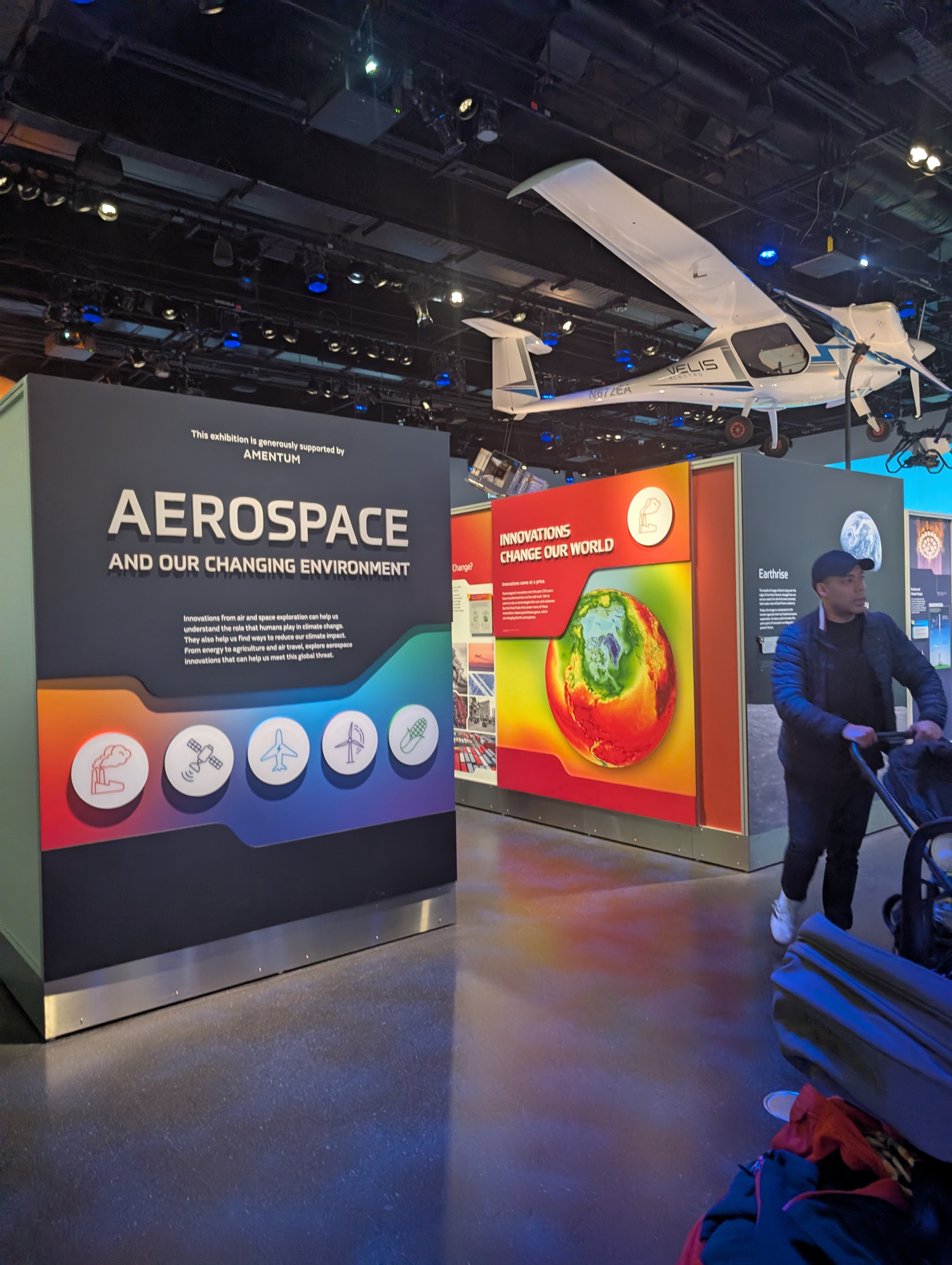
Entrance to the Aerospace and Changing environment
The second exhibit that we visited was an exhibit titled Aerospace and Our Changing Environment. The exhibit focused on global environmental problems and how aerospace technology could help solve these problems. For example, there was a display about how hydrogen fuel cells could be an alternative fuel for flight if they're stored and used properly. Using hydrogen fuel could be just as effective as current jet fuel; however, due to its sensitivity and proclivity to exploding if not handled carefully, it is not practical to use for fuel right now. This aerospace technology could majorly help with the environment by reducing the amount of fossil fuels being burned into the atmosphere. Another use of aerospace technology and science that can be used to help impact the environment is the use of satellites to monitor the environment and collect data, such as ice melting, or to take a look at the extreme greenhouse effects that are happening on Venus. By looking at the melting ice in Greenland, we can observe the present effects of climate change through aviation and aerospace technology. A final concept that was being displayed in the exhibit was using wind power as a source of energy. Wind power is a clean source of energy that could help us power whole cities if done right. An interesting part of the exhibit relating to the wind turbines was an interactive display where guests could rapidly spin a knob and watch tiny wind turbines spin, and depending on the speed, power up homes and entire cities. It was a fun, interactive display that showed how much power could come from wind power. Besides that one interactive display, this exhibit mainly consisted of paneled boards with information displayed through graphs, pictures, and text. There was lots of data being used in this exhibit, and the graph helped clearly convey this information. This exhibit seemed to be aimed towards an older audience because the language used and data being shown were more scientific and would be harder for younger children to understand or be interested in. This exhibit did not have many interactive components. It was mostly showing or displaying the information. An interactive component that could be used in the exhibit is having visitors rotate or look through a satellite's camera feed on a computer to see the different parts of earth and the ice melting.
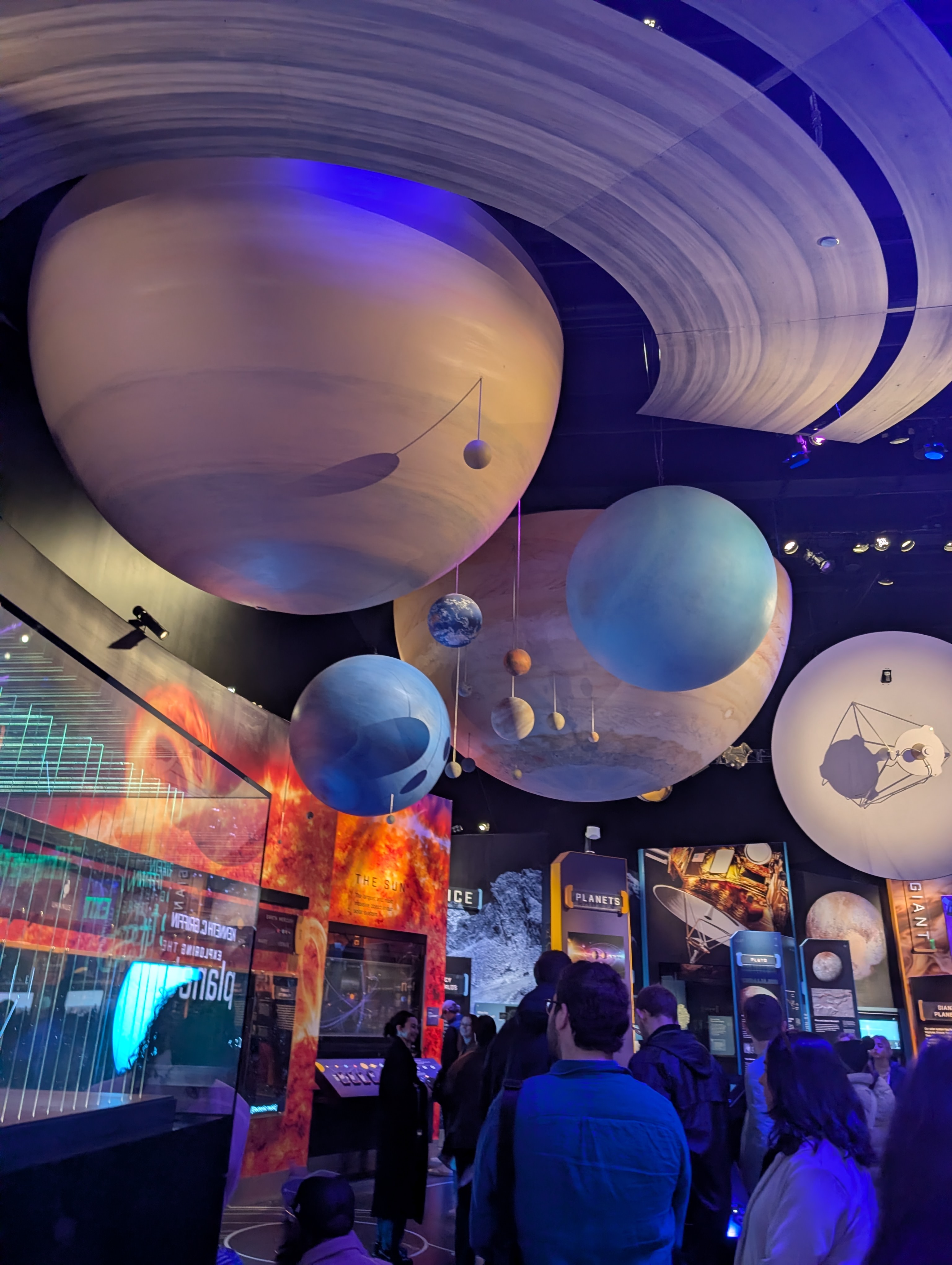
Solar system of planets
After watching a short movie in the planetarium, we headed up to the next exhibit, Exploring the Planets. This exhibit focused on all the planets in our solar system and allowed viewers to gain a better understanding of each one. Walking into the exhibit, a large model of the solar system greeted my roommate and me, where people stopped and took pictures of the mini solar system. From there, visitors could learn about what could be considered a planet. Through a text display, we learned that there are 3 criteria that a planet needs to meet in order to be considered a planet: it orbits around the sun , has enough gravity to make the object have a nearly round shape, and has cleared other large objects from the region. In the exhibit, there was an interactive display where visitors could turn a dial, choose one of the planets, play a game, and decide what the best source of fuel for a satellite or rover to explore that planet would be. I learned that far-off planets like Neptune have been explored by rovers that needed to be powered by nuclear energy due to their distance and solar power not being viable that far out. The interactive component of this information made it a fun guessing game, and I learned that every planet had a rover to explore it. From there, the exhibit was divided into the different compositions of the planets and was sorted into two broad categories, the gas giants and the terrestrial planets. In the gas giants section,there was information about Uranus which was presented through a text display and pictures of the tilted planet and its rotational pattern that is opposite from most other planets in our solar system. The Exploring the Planets exhibit also had actual models of rovers like the Marie Curie Rover, the flight spare to Sojourner, and the first successful Mars Rover for the visitor to look at and read more about the Pathfinder mission. The gallery also used some video displays to display information. This exhibit had some interactive components throughout the gallery, such as the computer screen, the guessing game, and an interactive panel where guests could lift a panel to see the answer to a question. The interactive components were effective in conveying information because they made the guests curious about the questions being asked. This hall seemed to be aimed at all ages because they had information that could be understood by all levels and had interactive components that younger audiences would enjoy while also displaying information that older people, with a higher education level, could still be interested in.
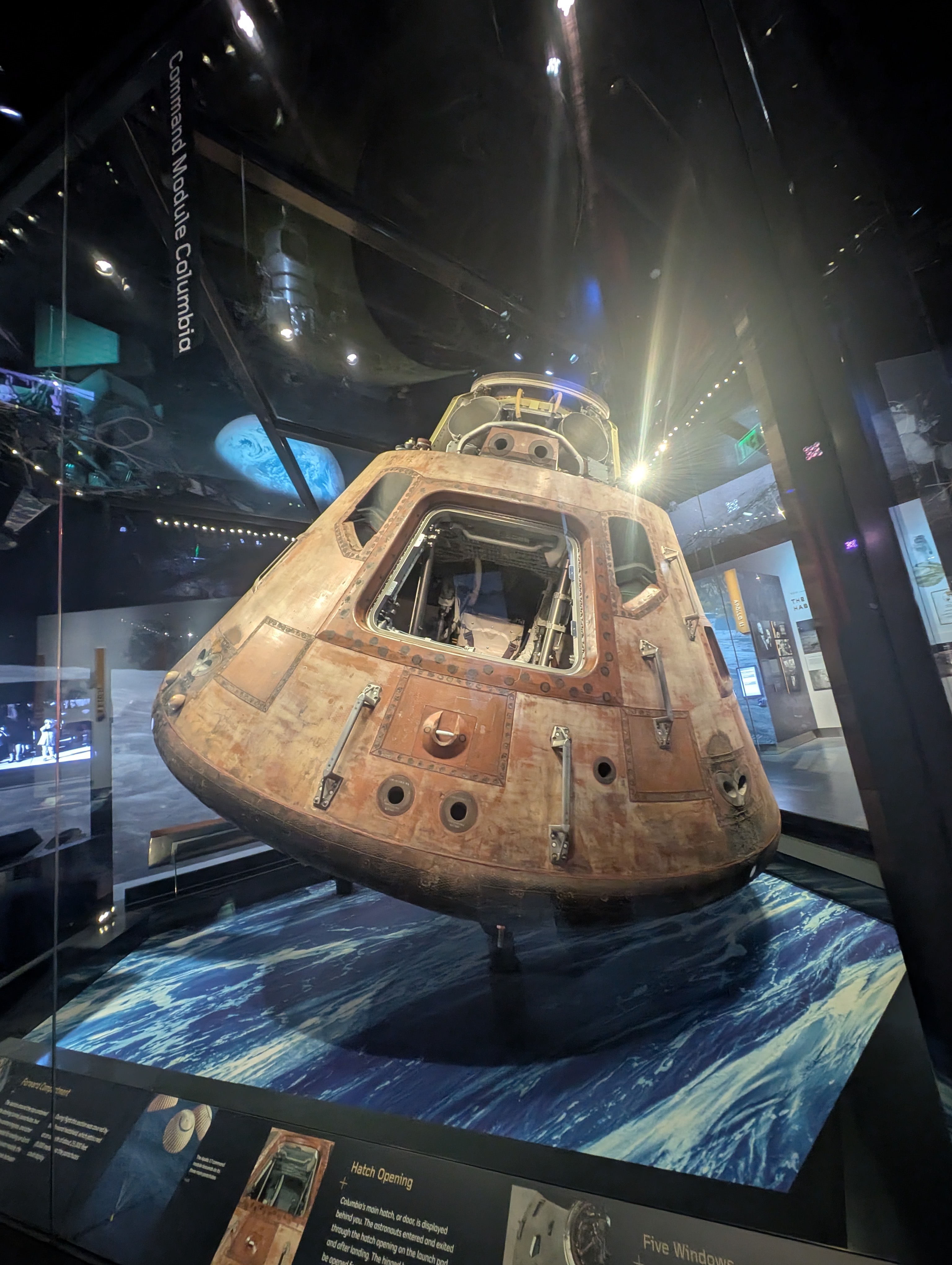
The Columbia
The last gallery that we visited that day was the exhibit titled Destination Moon. Detailing the journey to the moon and future exploration, the exhibit started with a glimpse of history and humanity's fascination with the moon and the wish to explore it being displayed for centuries through film, books, and art. In the exhibit, information about the first primate in space was displayed, and accompanying it was the capsule where the chimpanzee flew. The exhibit was mostly displayed in chronological order, detailing how the space race started and the many steps and trials that it took for the first man to walk onto the moon. There was information about the challenges of finding the best landing spot on the moon. Using data and images from lunar orbiters, NASA determined that the best landing zone would be the Sea of tranquility due to its safety and flatness. Uneven terrain would make it difficult to navigate after the sun rose due to loss of visibility. The journey to the moon was marked by many challenges and tragedies. During a countdown rehearsal , 3 astronauts on the Apollo 4 got trapped in the cockpit after a fire broke out. The 3 tragically died of asphyxiation, inhaling toxic fumes after they couldn't escape through the hatch door. This incident was a major setback, but it also highlighted the need for a better, quicker way for astronauts to escape in an emergency. The display had a picture of the three men who died, as well as the actual burned-up heat shield hatch that prevented their escape. The heat shield had text displaying the information as well, explaining why the hatch failed to be easy to operate and why it was made in the first place. The exhibit continued exploring the achievements and setbacks of the space missions. Through the use of display of real-life items like the Columbia command module, or Neil Armstrong’s space suit, viewers could view actual pieces of history. Finally, we reached July 20th, 1969, the day that the crew of Apollo 11 reached the moon. The exhibit had a column in the room detailing the days and hours leading up to this day as well as the aftermath. Alongside one wall were medals of honor presented to the crew after their goodwill tour as well as a map of the world showing where the medals came from. The graphics and medals showed what a big deal and honor this mission was for the Apollo 11 crew. The education level of this hall seemed to be aimed for all ages because the data and graphics made it interesting for any audience to enjoy. This exhibit did not have many interactive components. An interactive component that could have been added is a game where users have to try to land the landing module to see how difficult it is and what conditions make for an easier landing.
Astronomy is a difficult subject to portray in museums since information is constantly changing. The exhibit designers portrayed astronomical models with data and facts that we currently have to support what they are showing. If some major new information changed what they knew about an astronomical topic, such as Pluto becoming a dwarf planet, then they put in the new info while adding why this information changed. For updated information that visitors could find, there wasn’t really any way to easily find this information as a visitor. It seemed like the designers tried to keep the information as up to date as possible while adding changes or major revelations.
Overall the excursion to the Air and Space Museum was informative and I learned a lot about what lies beyond in the night sky.