


American Museum of Natural History:
November 22 2025, New York City:
Moonlight glowed dimly under the misty night, the sun's rays not yet there to kiss the horizon. Through the haze of sleep, I drowsily opened my eyes, being greeted by the darkness of my room. Looking sleepily at my phone, I realized that it was November 22, 2025, the day of the scholars' excursion to the American Museum of Natural History in New York so we could learn about different parts of history and science. Slowly getting up, I began to get ready for the day ahead. When I arrived in the lobby of Centreville, I was greeted by the sight of about 45 other groggy students milling around the lobby waiting for everyone to arrive. On a nearby bench, a small assortment of doughnuts, fruits, and Pop-Tarts was laid out for us to snack on for breakfast. Finally, after checking that everyone had arrived, the group was loaded onto the bus. The coach was glowing with red from the interior lights of the bus, cutting through the mist and dew clinging onto the ground from the rain of the night before. Sitting on the bus, my roommate and I gazed out of the window as the bus slowly pulled out of the Centreville parking lot. As the bus eased into the highway, I felt my eyelids growing heavy, watching the few early risers pass by in a blur in their cars. Putting on my sunglasses to shield my eyes from the glaring TV screen up above, I drifted off into a light sleep, tossing, turning, contorting in a futile attempt to find a comfortable position. A few hours later, I was pulled awake by the sounds of the other students on the bus and the sounds of Professor Merck's voice telling us of our imminent arrival. Looking out the window, my roommate and I gasped in excitement, looking at the glowing city of New York. Driving by, we saw glimpses of the billboards flashing with the latest products and ads, the edges of Central Park in the peripheral of my vision, buildings towering above me heading towards the sky, looking down onto the sidewalk, I saw throngs of people in the streets rushing to and fro as cars weaved and tangled through the streets.
When we finally reached the museum, we gathered inside and received our tickets. Our first stop and tour of the day was the museum exhibit Impact: The End of the Age of Dinosaurs, a brand new exhibit that had recently opened earlier in the week. Focusing on the asteroid impact that caused the fateful extinction of the dinosaurs as well as over 75% of species on Earth, the exhibit aimed to inform visitors about life before, during, and after the extinction event. As we gathered around Professor Holtz at the entrance of the exhibit, he addressed us about the importance of museums for research and conveying information to their visitors, and how museums were designed in a specific way to educate. Afterwards, all the members of Science and Global Change gathered around the triceratops further in the exhibit to take group photos. Flashing the symbol of scholars, we smiled as the camera went on, immortalizing the moment forever. Afterwards, we were free to explore the exhibit. Venturing further into the exhibit, I observed the time before the extinction, where life was abundant, and animals like the gigantatypus salahi and dinosaurs roamed the Earth. The displays had information such as what modern ancestors descended from those animals ( the gigantatypus salahi, for example, is an ancestor of the modern-day sea turtle), where they could be found, as well as the scale of the animals compared to humans or other modern-day animals. The displays at the beginning of the exhibit clearly showcased the abundance of life that was on Earth and how different life was before the great extinction.
Then I turned the corner. Shadowed in an ominous red light, curtained and sectioned off, was a mini amphitheater where audience members of all ages were seated on the red cushioned seats. In the front was a large curved screen playing a video. Taking a seat in the back of the room, I watched as children excitedly ran back and forth from their seats, bouncing around under their parents' watchful gaze. After a minute, the video started once again, and I could finally watch it in all of its entirety. Detailing the asteroid that hit the planet 66 million years ago, the video took us back in time to the moment the asteroid fell through the sky and made an impact. Going in depth about the immediate effects of the asteroid, the video described how the shockwave radiated along the Earth for hundreds of miles, instantly killing many as earthquakes and tsunamis swept across the nearby areas. But it wasn’t just the immediate impact that caused the devastating extinction; it was its aftermath as the sky turned dark as smoke and dust collected in the atmosphere, raining down burning acid and fire and blocking out sunlight for over a year. Any animal that wasn’t able to escape into the abyss of the ocean or deep underground perished, withered, and became extinct. Through the use of visuals to accompany the audio and easy-to-understand language, the video was easy for us to understand and for most of the younger audience to learn something new. The display was able to relay the concepts in a way that was understandable for a casual visitor through the engaging visuals, which illustrated what was happening, so almost anyone could gain a general understanding of the asteroid impact.
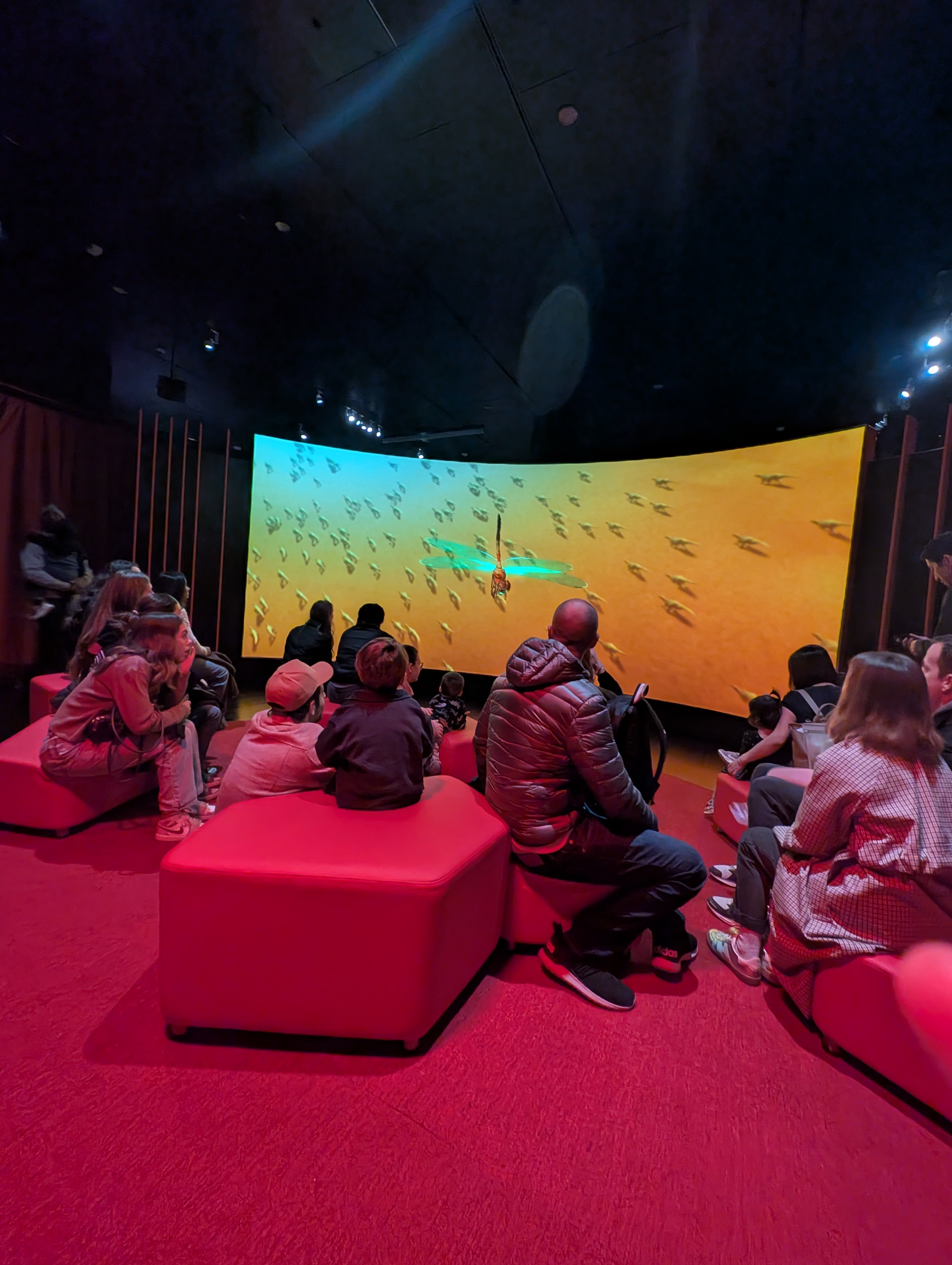
Video displaying the asteroid impact
As I proceeded further into the exhibit, I noticed that the color of the display titles had shifted from green to a blood red, highlighting that in the chronological timeline, this was post-asteroid, and that this area would deal with the planet afterwards. Displays in this section of the exhibit had many different media to present the content, including interactive displays like a game to see if a species of your choosing would’ve survived the extinction, and artifacts that could be touched, including a fossil ammonite, showing how many species went extinct and how, through certain traits or events, others were able to survive. The mix of many different modes of presenting the information, from audio, visual, and touch, allowed for the content to be learned in many different ways, which was engaging for audiences of all ages to read and understand.
Rounding the corner of the exhibit, another leap in time occurred. This time, we were following life reestablishing itself after the asteroid, as the remnants of life slowly emerged from the depths of the planet and, painstakingly over the span of hundreds of thousands of years, repopulated and evolved into the ancestors and descendants of the animals we see today. The exhibit makes the asteroid impact that occurred over 66 million years ago relevant to today by connecting the event to modern life and how the extinction event led to new creatures dominating the planet, evolving, and changing. It also highlighted how devastating extinction events are and how they impact the entire world, and another extinction event could be on its way. The use of actual models of what the creatures looked like was another way that the exhibit presented its information in an effective way because people, no matter what their age, will be intrigued by the ginormous animals in front of them, putting the size of humans to scale, as well as giving a closer visual of what the creatures are going to look like. The information presented here was easy for even a casual audience to understand, and the short displays and text hovered next to the models. While the exhibit was short, it was abundant in information. It was very interesting to learn about, while making it possible for everyone visiting the museum to enjoy.
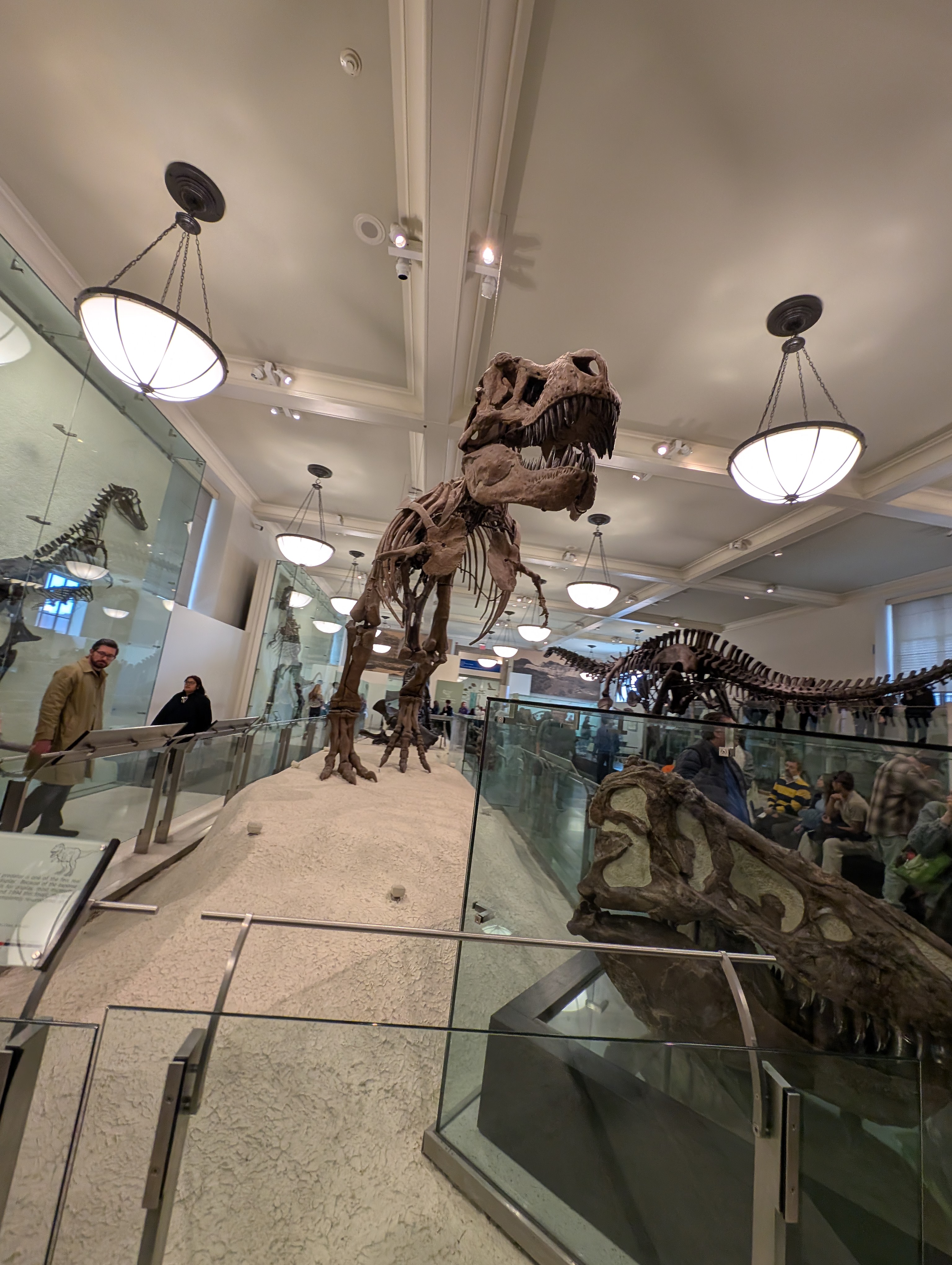
Fossil of a T-Rex
Joining Professor Holtz and a medium-sized group of students, we enter the fossil hall. Every museum exhibit is organised in a specific way that is designed to make the digestion of information smooth and comprehensive for the viewers to follow along. The fossil hall was designed to resemble a cladogram. A cladogram is a way to organize species over time as they evolved and shows the evolutionary relationships between them. The cladogram is shaped like the branches of a tree, and species that are evolutionarily closer to one another will be positioned near each other. Each branch of the tree showcases a different trait that any species following that branch in the tree will have. The way this museum exhibit was designed, the cladogram started off from the earliest traits in evolutionary history, then as patrons walked further down the hallway, a new branch with a certain characteristic was formed, highlighting the evolutionary history of these animals. We started the tour off by looking at the fossils of a dinosaur that was marked in the branch of the cladogram, the vertebral column, and the brain case. Afterwards, we continued through the exhibit and saw even more dinosaurs, including the carnivorous dinosaurs, bony-headed dinosaurs, and dinosaurs with horns on their heads. While we were guided through the exhibit, I noticed that the display utilized many modes to convey information, such as using dinosaur skeleton models or diagrams of their anatomy, as well as displays of individual bone parts throughout the exhibit. A highlight of the tour was when Professor Holtz explained to us that, unlike many other animal species, dinosaurs had an equal proportion of cartilage to their size. In many other species, as they grow, the amount of cartilage in the animal's body is small, but dinosaurs have a lot of strong material. Paleontologists theorized that it was the large amounts of cartilage that allowed dinosaurs to grow to such enormous sizes. Another interesting thing I learned was that there were air sacs in the dinosaurs that also possibly could have contributed to their large sizes. While a lot of the information in the exhibit and tour was interesting to learn, some of the designs of the museum were outdated. For example, it used to be believed that the T. rex was closely related to the allosaur, and the museum labeled them under the same family and believed that the legs of the T. rex were a similar structure to the allosaurs, but they soon learned that they were not closely related and had a different leg structure. But the museum had already displayed the allosaur bones and T. rex close to one another in the exhibit, and it was costly and impractical for them to move the exhibit around. It would be challenging for the museum to rearrange the entire exhibit with how fast information is constantly being discovered, especially rearranging where the fossils are being displayed due to the time and delicacy needed to move them. But to address this challenge, the museum could instead write about how they discovered the relationship between allosaurs and tyrannosaurus rexes to not be closely related, that way there isn’t misinformation, while not having to move the entire fossil around. Another outdated piece of information that was in the museum was that velociraptors were believed to be larger, faster dinosaurs, like how they are depicted in movies like Jurassic Park; however, paleontologists now know that they are actually much smaller. The museum could convey this information by showcasing the dinosaur that they believed the velociraptor was the size of, and then put the actual velociraptor next to it to showcase the difference in size and highlight the belief and reality. It felt like stepping back in time, walking through the fossil hall observing the sheer magnitude of the creatures that once roamed the earth as evolution caused certain traits to appear, fundamentally changing the way species looked as they adapted to the world around them.
Following the fossil hall, my roommate and I had about half an hour to look around before making our way back upstairs to see the collections core. Wandering around the museum, we made our way into the exhibit for Asian peoples. There, we saw various artifacts of clothes, art, everyday objects, and bits of history of numerous Asian cultures like India, China, and Korea. Unfortunately, we didn't have the time to go through the entire exhibit before we had to leave, but the exhibit had a lot to learn about.
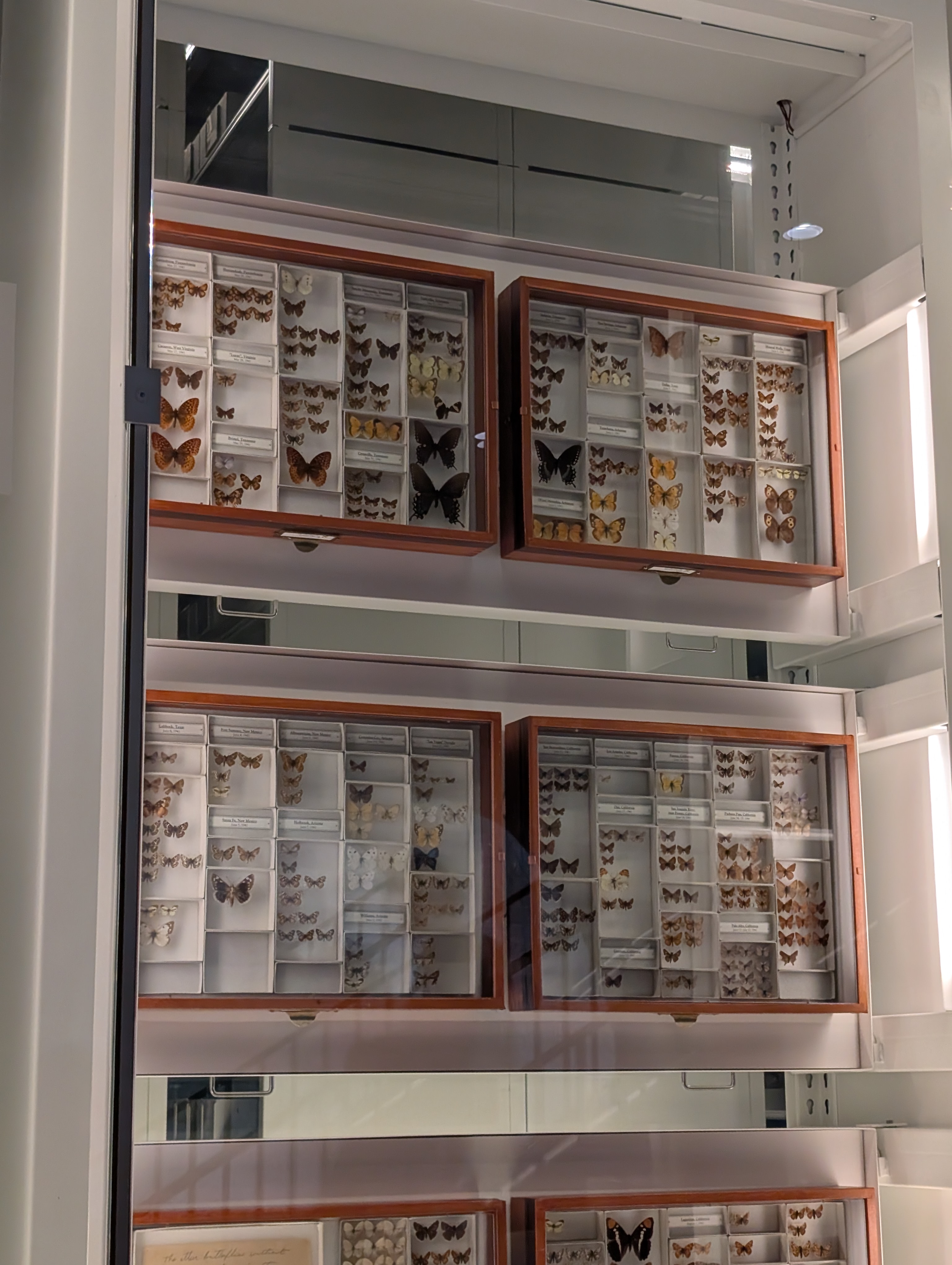
Butterflies pinned for a collection
Making our way back upstairs, we joined Dr. Fletcher for a tour through the collections core. There, we learned about the importance of collections for science and how preserving specimens and objects is vital for studying history and science, as each specimen gives valuable insight into the past and the region that the specimen hailed from. During the tour, we learned that it was important to have many specimens within the same species because it gives variation in the collection that mirrors the populations, age, sex, region, and even subspecies. One of the species we learned about was butterflies. Butterflies and other insects are pinned to be preserved, laying them flat and spreading their wings out to put them on display. Once you dry out a butterfly, they can be preserved and displayed virtually forever. Another type of specimen we learned about on our tour was stingrays, which we discovered were collected through clear staining. Clear staining is a method that gets rid of any soft tissue while staining the cartilage and bones. Using clear staining, it can be useful in studying the development of an animal. For example, we saw the development of stingrays through a clear staining, where we were able to see the bones and cartilage of the stingray grow bigger as it developed and matured, making it important for studying the growth of animals or even to observe their evolutionary history through development. There are many reasons to collect a specimen; they offer so much data about the species and give a snapshot of the past. For example, on display in the collection were cane toads that were pickled with ethanol in a jar. Cane toads have become an invasive species in parts of the world. They have poisonous glands that kill any predator that attempts to digest the frog, allowing them to quickly grow and overwhelm the areas that they invade. By studying the cane frog collection, we can observe that the frogs have evolved to invade faster. Their legs become longer and longer, allowing them to spread and travel further distances at a faster rate. The evolutionary history of the frogs is important for scientists to learn about to study how they spread so fast and what allowed them to travel so far.
Collections do bring up ethical questions, of course, with concerns about the ethics of killing an animal to collect them and their conservation value. But the scientific value of collections is also extremely important. In the end, species can be collected after they die, such as collecting the shells of turtles after they pass away. Care can be taken when collecting species to do it humanely, as well as making sure to only collect them with scientific intent and never kill off too many in a population. So while it may seem cruel to kill an animal for a collection, if done carefully and with consideration for the environment around it, collecting specimens has vast scientific value.
Touring the collection hall gave me awareness of the importance of collections and the other value of museums, which is to house these collections. Through the collections, scholars of all sorts can study these specimens, potentially leading to many breakthroughs.
Following the collection's core, we headed upstairs to the planetarium to see the space show. The title of the show was Exploration of the Milky Way, and it focused on the expanse of the universe. It focused on planet Earth and how it orbited the Sun. Then, as scientists expanded our understanding of the universe through telescopes and satellites, they discovered that our sun is also orbiting through other stars, systems, and galaxies in the universe. It puts into perspective how tiny Earth and even our sun are within the universe. It was clear that the images being presented in the planetarium were based on real measurements and data, as they were based on readings from the telescope, and the distances being displayed showcased the scaling of how far apart objects were from each other. Most of the information was new to me and surprised me, like how there were mini galaxies that were orbiting around bigger ones that caused stars like the sun to form. The planetarium showcased the scale of our universe and how stars and planets are formed using scientific data in the show.
Pulling out of the bus in New York, I watched the bright light of the city fade away in the distance, as exhaustion began to tug on me. I reflected on how the American Museum of Natural History had clearly been designed with a wide audience in mind, from young children with their parents to researchers as well as people with varying levels of mobility and ability. For example, since people of all ages come to the museum, the information is presented in a way that is engaging and understandable. The language they use in the display is simple enough that younger children can get a grasp of the things that they are learning. For example, in the video displayed in the The End of the Age of the Dinosaurs exhibit about the asteroid, the general premise of the video could be understood by someone with no knowledge of the topic, like children, but it also had details in it that researchers could also walk away with a deeper understanding. A second example of how the museum was designed for a wide variety of people is through the various media through which the information is displayed. The exhibits combined different models to display their information from audios in videos, or sections that encouraged visitors to touch the bones of an actual dinosaur, or displays to read information accommodating people of different learning styles and sensory abilities to enjoy the museum. A final way the museum accommodated a wide range of different people was for people of different mobility. The exhibits and layout of the museum were wheelchair accessible allowing them to easily navigate the museum. Overall, the museum aimed to appeal to a wide array of people through its presentation of info as well as its accessibility to navigate through the building.