


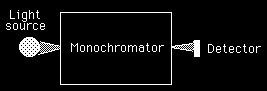
Variable sheet:
---------------------------------------------------------------------------------------
St Input     Name    Output    Unit      Comment
             freq    2.998E13  Hz        frequency (Hz)
             E       1.987E-20 Joule     energy (Joule, erg, eV, kcal/mole)
             v       1000      cm-1      wavenumber (cm-1)
   10        lambda            µm        wavelength of light (nm, A, µm, cm)
   1         m                           order (unitless)
             d       .01       mm        grating constant (cm, mm, µm)
             theta   2.9671739 degrees   rotation angle of grating (radians, de
   15        Phi               degrees   monochromator takeoff angle (radians,
             alpha   -12.03283 degrees   incidence angle (radians, degrees)
             beta    17.967174 degrees   diffraction angle (radians, degrees)
   100       lines             lines/mm  grating ruling density (lines/mm)
             AngDisp .00010513 nm-1      Angular dispersion (mm-1, nm-1)
             LinDisp .00525633 mm/�      Linear Dispersion (mm/nm, mm/A)
             RLD     19.024668 nm/mm     Reciprocal linear dispersion (nm/mm, A
   .5        Fm                m         Focal length on monochromator (mm, cm,
             Sg      .01902467 µm        Geometrical spectral bandpass (mm, µm,
             S       .01922467 µm        Spectral bandpass (mm, µm, nm, A)
             Snu     1.9224668 cm-1      Spectral bandpass (cm-1)
   1         H                 cm        Slit height (cm, mm, µm)
   1         W                 mm        Slit width (cm, mm, µm)
             Sd      .2        nm        diffraction limited resolution (mm, µm
             N       5000                Total number of lines in grating (unit
   50        Wg                mm        aperture (mm, cm, m)
             FSR     .5        µm        Free spectral range (mm, µm, nm, A)
             omega   .00978028 sr        acceptance solid angle, steradians
             Fnumber 8.961263            F-number of monochromator
             Ap      24.450708 cm2       grating area viewed from entrance slit
             As      .1        cm2       Slit area (cm2, mm2)
             PhiO    2.3938E-7 watts     Radiant power passed by monochromator
             Blambda .00002573 W/sr/nm/c Source spectral radiance (W/sr/nm/cm2)
   .5        Top                         Transmission factor of monochromator
   .5        emisiv                      emissivity of blackbody
   1200      Tb                K         Temperature of blackbody (K, C)
   1E9       Dstar             cm-rootHz Detectivity of detector (cm-rootHz/W)
   1         DeltaF            Hz        electrical bandpass of detector electr
   5         Ad                mm2       area of detector
             SNR     1070.537            signal-to-noise ratio for detector lim
             B       1.871113  W/sr/cm2  Total radiance over all wavelengths
             peak    2.4141667 µm        Peak wavelength  (nm, A, µm, cm)
             flux    1.205E13  Hz        Photon flux, Hz, on detector
             exponen 1.1983333           exponent of e in Planck's equation
             LambdaT 12000000  nm K      product of lambda and T, nm K
             D       4.47214E9           detectivity (W-1)
             nm      10000     nm        wavelength in nm
             shot    1097737.6           Signal-to-photon-noise ratio
   .1        klam                        Quantum efficienty of photon detector
---------------------------------------------------------------------------------------

Rule sheet:
---------------------------------------------------------------------------------------
* d=1/lines
* AngDisp = m/(d*cos(beta))
* LinDisp = Fm*AngDisp
* RLD=1/LinDisp
* Sg=W/LinDisp
* S = Sg+Sd
* Snu=.1*S/(lambda*lambda)
* Sd = lambda/(m*N)
* N = Wg/d
* theta=beta-Phi
* alpha=theta-Phi
* m*lambda=2*d*cos(Phi)*sin(theta)
* FSR=lambda/(m+1)
* omega=Ap/Fm^2
* Ap=Wg^2*cos(alpha)
* As=0.01*W*H
* PhiO=Blambda*As*omega*Top*Sg*1e6
* Fnumber=Fm/sqrt(4*Ap/pi())
* lambda = 1/v
* Blambda = emisiv*1.19111E16*nm^-5/(exp(1.438e7/(nm*Tb))-1)
* E = (6.6261E-34)*freq
* freq = (2.998E10)/lambda
* B=emisiv*1.8047e-12*Tb^4
* peak=2.897e6/Tb
* nm=lambda*1e7
* exponent=1.438e7/(nm*Tb)
* LambdaT=nm*Tb
* Dstar=D*sqrt(Ad*DeltaF)
* SNR=PhiO*D
* flux=PhiO/E
* shot=klam*flux/sqrt(klam*flux)
---------------------------------------------------------------------------------------
Download the Dispersive IR model.
[RETURN] to Chem 623 home page.