Postal address:
Department of ECE
University of Maryland
8223 Paint Branch Dr.
College Park, MD 20742, USA
Research
Combinatorics and statistical mechanics of information storage in networks:
Given a graph $G$ with vertices in the set $V$, we assign bits to the vertices $v\in V$, with the assumption that some of
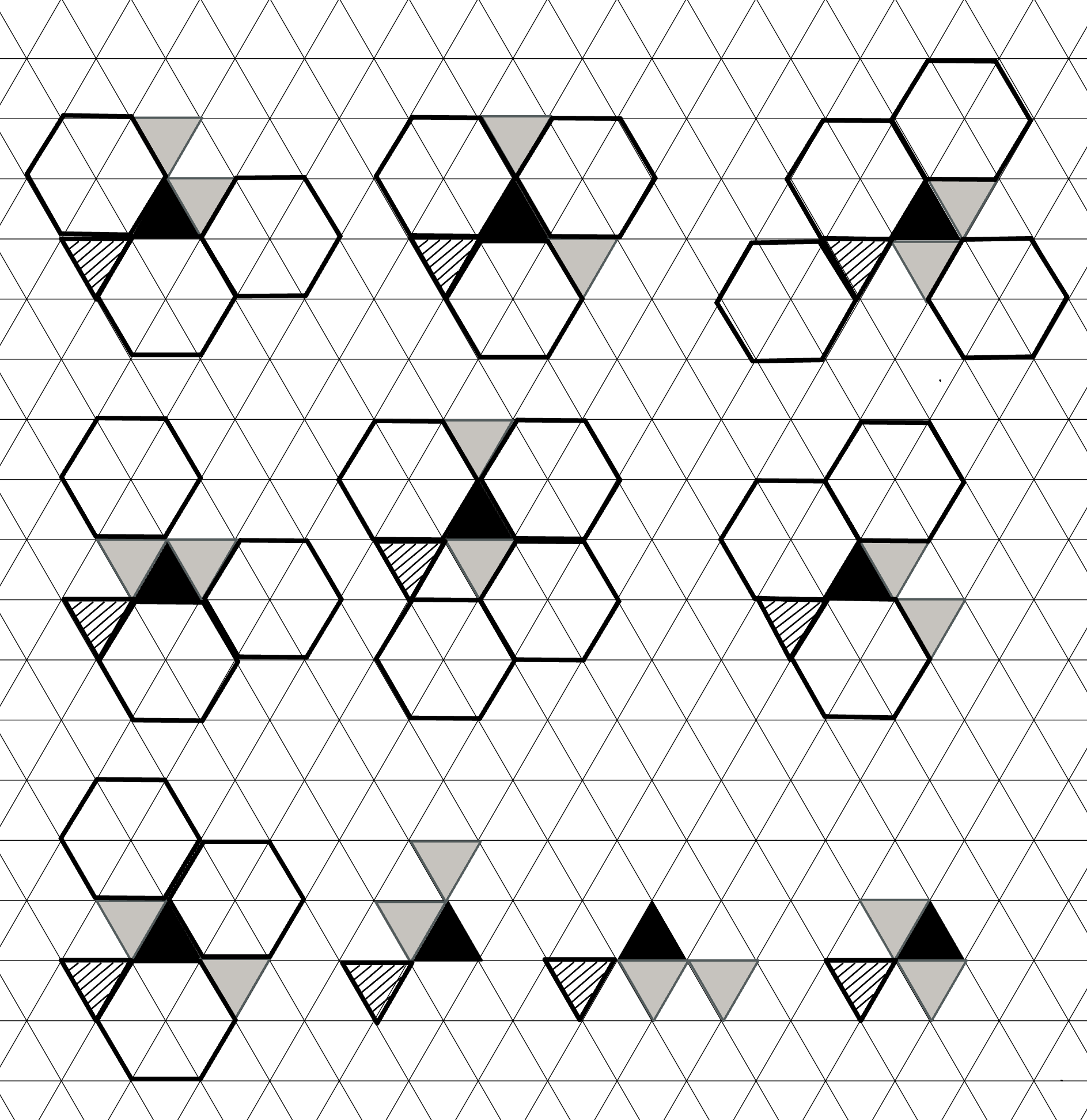
the assignments are disallowed. For example, we may assume that no pair of adjacent vertices are both assigned a 1. An assignment that conforms with this constraint specifies an independent set in $G$. Sampling a configuration $\omega\in\{0,1\}^G$ from the Gibbs distribution with activity parameter $\lambda$ gives rise to the hard-core model on $G$, a classical problem in statistical mechanics. In recent works we studied a version of this model with maximal independent sets, proving some results about phase transitions in the low- and high-activity regimes. See the figure below.
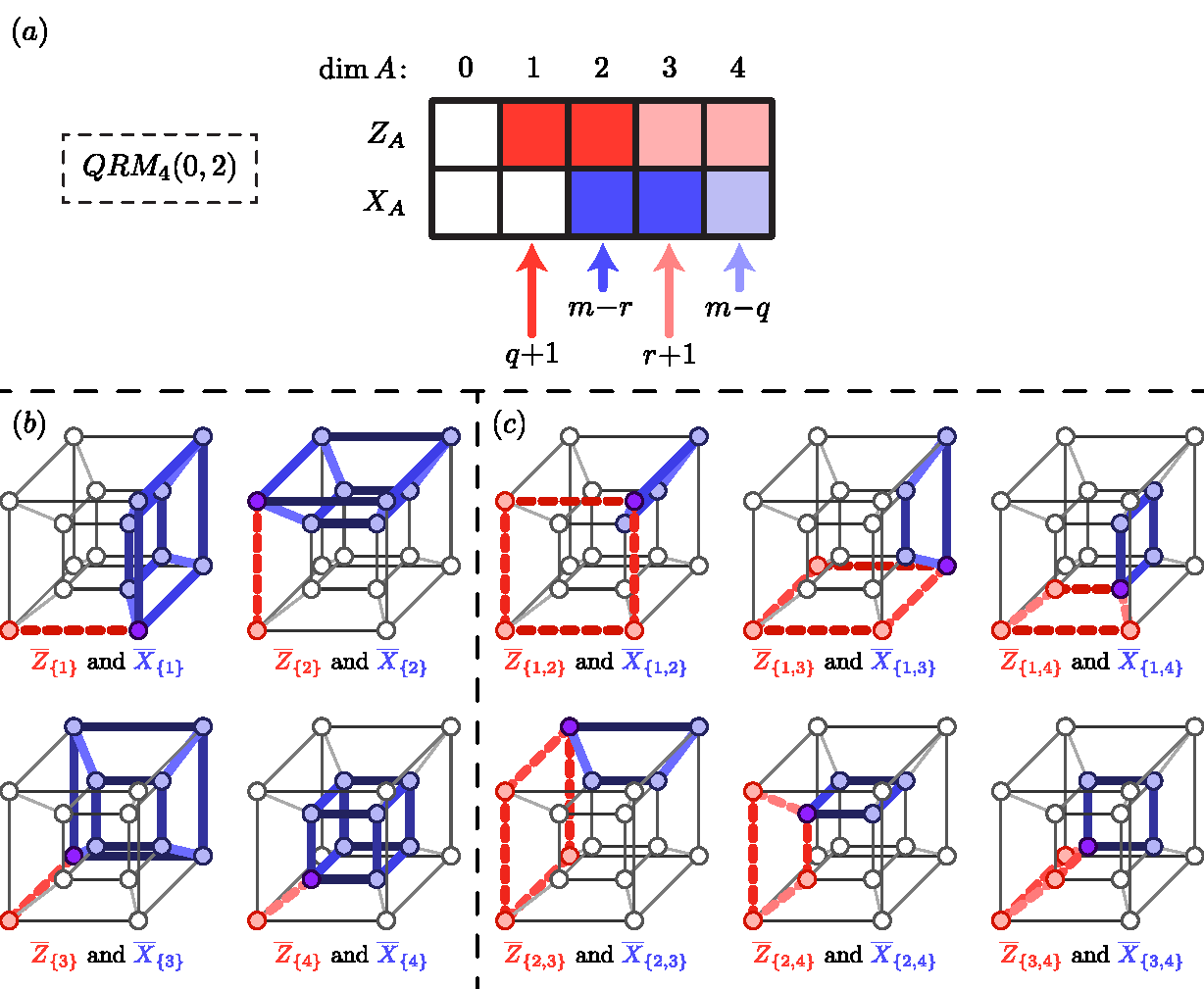
Quantum codes, in particular, qubit codes and their transversal logical gates; permutation invariant codes for correcting deletions and amplitude damping noise; bosonic Fock state codes; approximate quantum error correction.
Codes and uniform distributions: Here one is interested in characterizing binary codes and codes in other
finite metric spaces that approximate the uniform distribution on the space. Applications of such codes could include derandomizing algorithms,
approximation theory, probability of decoding error, image processing, and concept learning (uniform laws of large numbers and VC dimension).
These problems are also connected with constructing energy-minimizing configurations in metric spaces.
Continual support of the US National Science Foundation is gratefully acknowledged.
Contour counting from the paper on the maximal hard-core model on the triangular lattice.
Logical operators for quantum RM codes (image created by Nolan Coble)